
Cashflow & Capital- Super Assumptions
Super Guarantee (SG) and Salary Input
- The assumed Super Guarantee rate is derived from the rate entered by the user within the Fact find- Personal Details page.
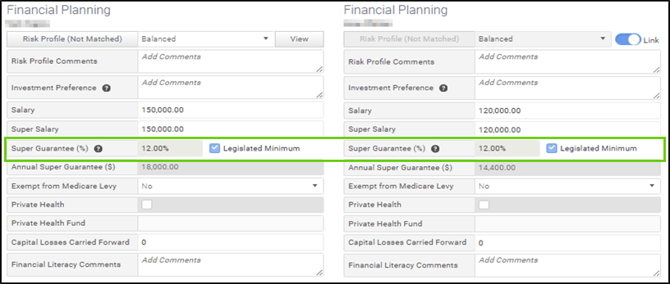
- Super Guarantee is calculated based on the client’s specified salary.
Contributions
- Concessional contribution availability applied within the modelling is sourced from the Fact Find- Contribution Worksheet. If client has accumulated catchup concessional provisions, the information will be included in the modelling if it is available in the Contribution worksheet. In the absence of entered data, the system will default to the concessional contribution limit for the current financial year.
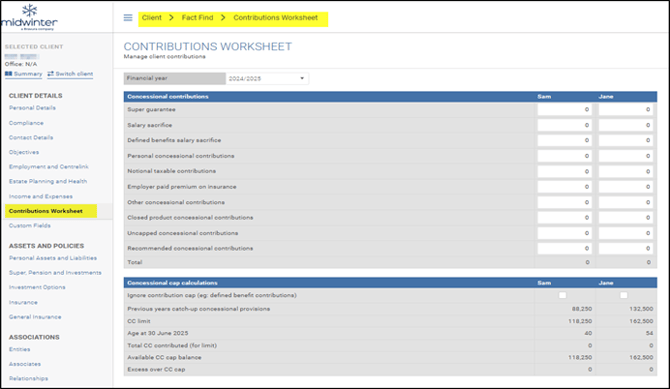
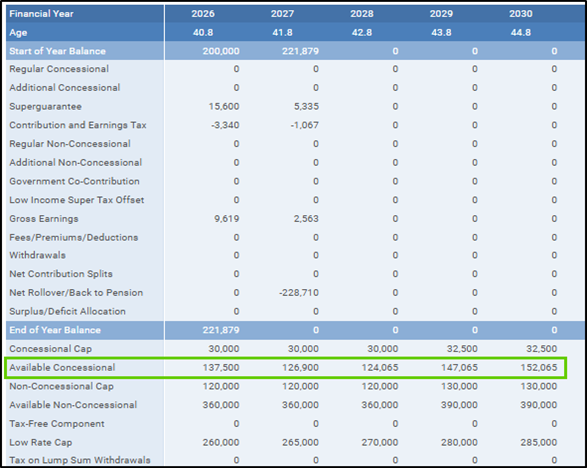
- The regular concessional contribution and regular non- concessional contributions will come from client cashflow.
- The concessional (bank account) and regular non- concessional contributions will be withdrawn from the cash account and added to the super balance in the month/date selected.
- Concessional and superannuation guarantee contribution splitting values must fall within the range of 0% to 85%.
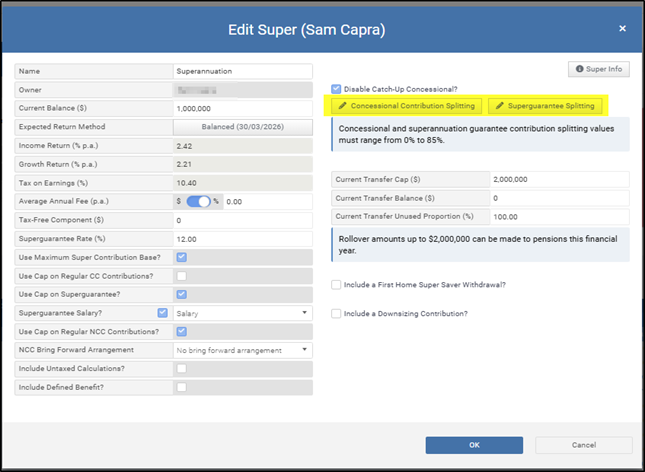
- Defined benefit contributions set to end at retirement will be pro-rated in the retirement year.
Transfer Balance Cap (TBC) Adjustments
- The following events impact a client's transfer balance cap and are considered by Cashflow & Capital in determining the client's remaining cap:
- Rollovers from Super to Pension (increases amount of cap used)
- Commutations/lump sum withdrawals from pension (decreases amount of cap used)
- Rollback from Pension to Super (decreases amount of cap used)
First Home Super Saver Scheme (FHSSS)
- Individuals can withdraw 100% non-concessional and 85% of (voluntary) concessional available for FHSSS. For example:
- Individual contributions contributed $15,000 a year for two years of concessional contributions.
- The maximum they can withdraw under the scheme is $15,000 * 0.85 * 2 = $25,550 (+ earnings – Tax + 30% tax offset)
- All tax is assumed to be paid from the net lump sum (after a 30% rebate is applied). This means the FHSSS withdrawal will not impact your tax projection.
- Associated earnings calculated on these contributions using a deemed rate of return – this is based on the 90-day Bank Bill rate plus 3% (shortfall interest charge rate).
- A first-in first-out rule applies – this means that contributions you make in an earlier financial year are counted before contributions in a later financial year. Contributions you make within a financial year are counted in the order you make them.
- A simultaneous contributions rule applies – this means that if you make an eligible concessional contribution and an eligible non-concessional contribution at the same time (for example, in the same payroll process), your non-concessional contributions are taken to be made first.
- If you make your contributions within a financial year and you claim a deduction for some or all the contributions, the resulting eligible non-concessional contributions (if any) are taken to be made before any eligible concessional contribution.
- The net lump sum withdrawal amount will be added to the cash account in the month/year stated.
Downsizer Contribution
- The downsizing contribution is available for any individual or couple who have sold a house and wish to add up to $300K each to Super. For this contribution, the member is not required to satisfy the work test.
Cashflow & Capital- Centrelink Assumptions
- The rates and thresholds used for Centrelink modelling in Cashflow & Capital are disclosed and regularly updated on Settings- Legislation- Centrelink page.
- The age pension details change each year in line with AWOTE (average weekly ordinary time earnings) available on Settings- Risk profiles- Default settings page. Midwinter is currently using 2.60% p.a. as AWOTE.
- For Centrelink purposes, the client will be considered a homeowner if they have a residential property at the start of the financial year.
- The Deeming rates used for income of assets are listed below:

- The income rules for Age pension use the below rates:
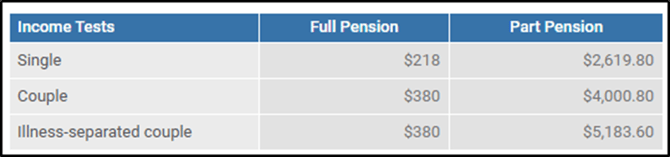
Assumptions for Centrelink calculations for first year of eligibility
For the assets test, balances are assessed at the start of the financial year, while the income test is based on annual income. As a result, if a client becomes eligible partway through the year, the initial Centrelink calculation may not fully reflect their actual entitlement.
To address this, the system includes an “Override Pension” feature, allowing advisers to manually input the pension amount the client is actually receiving for more accurate modelling.
Commonwealth Seniors Health Card
- The Commonwealth Seniors Health card eligibility assumptions for clients within cashflow and capital are:
- Be Age Pension age
- Australian resident by default
- Not receiving any sort of income support payment from Centrelink or DVA
- Meet income test
- The income compared to the relevant CSHC threshold is the sum (combined for couples) of:
- Voluntary concessional contributions
- Taxable income
- Account Based Pension deemed income
- Deemed income is calculated based on the end-of-year Account Based Pension balance in the individual’s retirement year, and the start-of-year balance in all other years.
- If Separated by Illness option has been selected for clients (couple), they may be eligible to receive a higher individual rate than other couples.
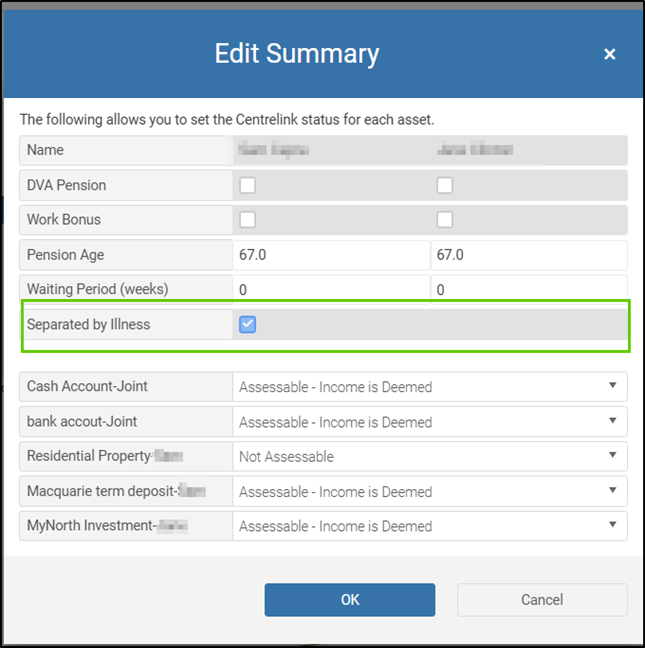
- The pension asset threshold, pension income thresholds, pension rate, pension supplement, and pension energy supplement values used for Modelling for Illness separated couples are disclosed on Settings- Legislation- Centrelink.
Work Bonus
- The work bonus logic assumes a $300 fortnightly employment income limit, with any employment income above this fortnightly threshold being offset against the available Work Bonus balance.
- The one-time $4,000 boost is incorporated into the cashflow and capital modelling. It applies at the beginning of the financial year when the individual reaches pension age, provided the financial year is 2024 or later. Additionally, for the first year of the projection, the boost is applied only if the individual had not reached pension age before the projection started.
- The modelling assumes that anyone with an existing age pension has already used their $4,000 bonus. The advisers can use the ‘Adjustments’ feature in Centrelink input to adjust the income if any amendments are required.